Live Music App
Reimagining Earbuds Live: A Home Screen Transformation
Company
Earbuds
Role
Product Designer
Responsibilities
End-to-end design, user research
JUMP TO

Summary
Success Rate
0 %
Positive Feedback
0 %
Prefer redesign to current
0 %
Usability Tests
0
We overhauled the Earbuds Home screen to enhance music discovery, navigation, and engagement in response to user feedback. Despite a small team and tight deadlines, our redesign included new social features, personalized recommendations, and a modern color palette, receiving positive feedback from usability tests. Though the project was not implemented, it showcased our dedication to user-centered design and potential for significant user engagement.
Problem
Our home screen was cluttered, difficult to navigate, and failed to engage users, prompting the need for a complete redesign to enhance user interaction and streamline navigation.
Goals
- Create a visually appealing and functional home screen.
- Simplify navigation to enhance music discovery.
- Implement social features to boost community interaction.
- Introduce personalized content recommendations.
Hurdles
- Team Size: Only two designers were working on this major overhaul.
- Scale of Redesign: The project required a complete transformation of the user interface.
- Time Constraints: We had limited time to design, test, and implement the changes efficiently.
Process
We went through a lengthy process that included conducting user interviews, defining success metrics, performing competitive analysis, and iteratively designing and testing prototypes to create a more intuitive and engaging user experience.
Steps
- Initial interviews: Conducted interviews with current users to understand needs and pain points.
- Success metrics: Defined success metrics to ensure the project’s success.
- Competitive analysis: Analyzed competitors to identify key differentiators and opportunities.
- User stories: Generated user stories to outline product behavior from a user’s perspective.
- Design: Developed new color palette, sketches, wireframes, high-fidelity prototypes, and tested prototypes with the Play app.
- Review: Conducted multiple iterations and reviews with team and users at each stage.
- Usability testing: Performed usability testing with 100 users to refine the final design.


Solution
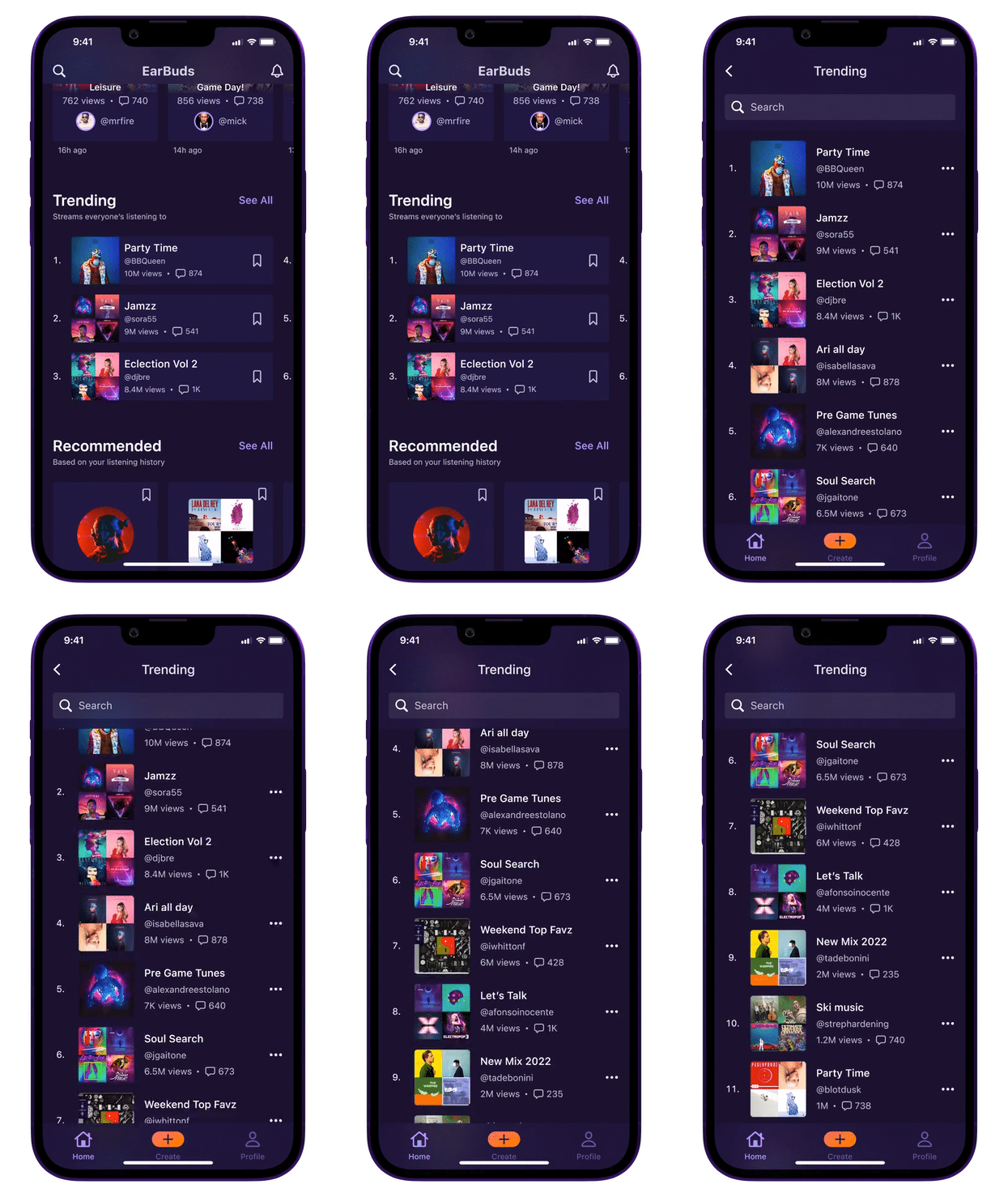
We revamped the home screen to be more intuitive and visually appealing, enhancing user interaction and streamlining navigation for a delightful music discovery experience.
Personalized Recs
We Implemented features to tailor content based on user preferences and behavior.
social features
Added new ways for users to interact and share their music experiences.
Visual Sections
Through card components, we created visual sections that were distinct for each content type.
Dark Mode
Focused on a fresh color palette to improve usability and capture the app’s dynamic nature.


Impact
Although the redesign did not go live, our design process yielded valuable insights and positive feedback, demonstrating the potential for significant user engagement and satisfaction. Key data points include:
user research
We conducted user interviews with 15 current Earbuds users, identifying key pain points and preferences in existing live music apps.
usability testing
We performed usability testing with 100 participants, achieving an 85% success rate in completing essential tasks like navigating sections.
Positive feedback
We received positive feedback from 95% of users who tested the high-fidelity prototypes, with particular praise for the personalized music recommendations.
preference for redesign
80% of testers said they prefer our redesigned home over their current home screen.
Reusable Components
We created 20 reusable components, enhancing design consistency and scalability.
Conclusion
Despite the redesign never being implemented due to a strategic pivot in the app’s direction to accelerate market fit, this project is a testament to our design team’s skill and passion. We fully embraced the design process, gaining invaluable user interviews and feedback insights. The experience was incredibly enriching, confirming the importance of a user-centered approach in product design.
Reflection
- Testing Importance: Emphasized the need for real user interaction testing to refine designs. Visual
- Design Balance: Learned the importance of balancing vibrant colors with user comfort and accessibility.
- Content Hierarchy Significance: Highlighted the critical role of content hierarchy in enhancing user navigation and content engagement.
- User Feedback Integration: The value of integrating user feedback directly influenced design effectiveness and user satisfaction.
Next Steps
If the project had been developed further, our plan would have included several exciting future features to enhance the user experience and broaden the app’s appeal:
future features
- Redesign Onboarding: Simplify and improve the onboarding process to ensure new users can quickly understand and engage with the app’s features.
- Add Content Around Scheduled Events: Collaborate with bands and creators to create engaging content for scheduled events, providing users with up-to-date information and exclusive content.
- Create Live and Single-Player Modes: Reintroduce live-streaming and single-player modes to offer diverse ways for users to interact with music and live events.
- Marketing Content: Develop marketing content to rebrand Earbuds, highlighting the new features and design improvements to attract and retain users.
Our "Super-Specific Who"
Young adults, 18–35, deeply embedded in music fandom communities.
The journey to understanding this audience—unraveling their unique needs, preferences, and challenges—was an essential precursor to our research and design efforts. For an in-depth dive into how we sculpted our target audience profile and why they’re pivotal to our project’s success, checkout the link below. This background sets the stage for our user research, guiding our approach to interviews and analysis with a clear vision of whom we’re designing for.


